
Sewer Easements in Brisbane: What They Mean for Your Build
Published Updated 5 min read
On this page
- What Is a Sewer Easement?
- Can You Build Over a Sewer Easement in Brisbane?
- How Does a Sewer Easement Actually Affect Your House Design?
- What Can You Actually Build Over a Sewer Easement?
- What About Stormwater Pipes and Easements?
- What If the Easement Runs Through the Middle of My Block?
- How Do You Find Out If Your Block Has a Sewer Easement?
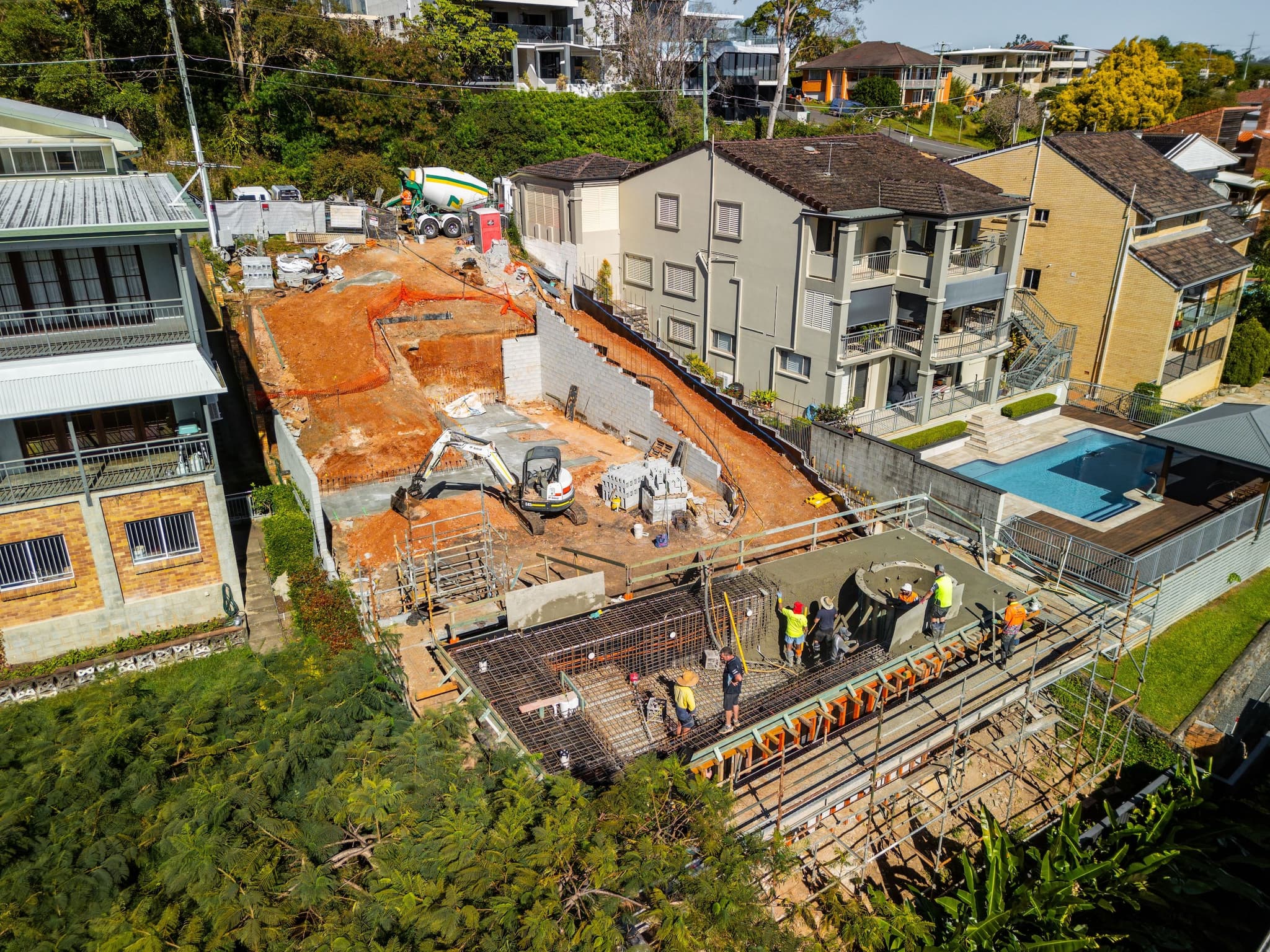
Finding out your block has a sewer easement running through it can feel like a dealbreaker, but in the vast majority of cases, it isn't. What it actually means is that part of your design has to work around a fixed constraint, not that the block is unbuildable.
This isn't a topic worth trying to reinvent, the actual rules belong to Brisbane's water authority and the Queensland Government, and we'll point you to them directly. What we can add, as builders, is what an easement actually means once you sit down to design a home around it.
What Is a Sewer Easement?
A sewer easement is a legal right that allows a service provider, in Brisbane's case usually Urban Utilities, to access, maintain, and repair sewer infrastructure that runs through or alongside your property, even though you own the land. It's registered on your property title, and it exists regardless of whether the pipe is visible above ground.
Building work over or near a sewer, water main, or stormwater drain in Queensland is assessed against the Queensland Development Code MP 1.4, a state-wide standard that applies whether the block is in Brisbane, Ipswich, or further out.
(If your block sits outside the Brisbane, Ipswich, Scenic Rim, Lockyer Valley, or Somerset areas, your local water authority may be Unity Water instead of Urban Utilities, the same principles apply, but approvals go through a different provider.)
Can You Build Over a Sewer Easement in Brisbane?
Often, yes, with the right approval. Permission to build over or near Urban Utilities infrastructure requires what's called a Build Over Asset (BOA) Approval, a distinct, formal process separate from your standard building approval. It exists to make sure whatever you're proposing won't damage the sewer or block access to it for future maintenance.
Brisbane City Council also draws a clear line worth knowing: Council doesn't provide advice on building over or near sewer or water infrastructure, that's Urban Utilities' territory. Council is only involved where stormwater drainage infrastructure is affected. Knowing which authority actually governs your specific situation avoids chasing the wrong approval entirely.
How Does a Sewer Easement Actually Affect Your House Design?
This is the part a utility company's own page won't tell you, because it depends entirely on your specific design, not just the rules.
- Floor plan routing. An easement effectively creates a no-build (or restricted-build) zone through part of your block. On a standard block this might just mean shifting a wall or a wing of the house a metre or two, on a narrow or already-tight block, it can genuinely dictate the entire floor plan, since there's less room to simply build around it.
- Foundation and structural decisions. Even where light structures (a driveway, a garden shed, sometimes a fence) may be permitted over an easement under a BOA approval, habitable rooms and load-bearing structures almost always need to sit clear of it, or be specifically engineered to protect the pipe underneath.
- Knockdown rebuilds specifically. If you're planning a knockdown rebuild, it's worth checking for an easement before demolition, not after. An existing easement may have shaped exactly where the original house was built, and a new design that ignores it can run into the same constraint the previous owner already worked around.
What Can You Actually Build Over a Sewer Easement?
| Structure Type | Generally Allowed Over an Easement? | Approval Needed |
|---|---|---|
| Garden beds, lawn, light landscaping | Usually yes | Often none, confirm with Urban Utilities if unsure |
| Fences | Sometimes | Build Over Asset (BOA) Approval usually required |
| Driveways and paving | Sometimes | Build Over Asset (BOA) Approval usually required |
| Sheds and lightweight carports | Sometimes | Build Over Asset (BOA) Approval required |
| Habitable rooms or the main dwelling | Rarely | Full BOA Approval and engineering, often not permitted at all |
| Swimming pools | Rarely | Full BOA Approval and engineering, often not permitted at all |
What About Stormwater Pipes and Easements?
Sewer and stormwater are often confused, but they're managed by different authorities in Brisbane. Sewer and water easements fall under Urban Utilities, as covered above, while stormwater drainage infrastructure and easements are managed by Brisbane City Council directly.
The practical principles carry across in the same way: a stormwater easement or drainage pipe running through your block creates a restricted-build zone, and building over or near it typically requires council approval before work begins, separate from any Urban Utilities Build Over Asset approval that might also apply if both types of infrastructure cross the same site. If your block has both a sewer and a stormwater easement, and on established Brisbane blocks this genuinely happens, both approval pathways need to be worked through, not just one.
The same title search that reveals a sewer easement will also show any registered stormwater easement, so it's worth checking both in the same step rather than assuming a clear result for one means the block is clear altogether.
What If the Easement Runs Through the Middle of My Block?
This is the hardest version of the problem, and it's exactly the kind of situation that benefits from a builder being involved before a design is finalised rather than after. Options typically include reshaping the footprint to sit entirely to one side of the easement, splitting living areas across the block in a way that treats the easement corridor as a driveway or garden zone rather than usable floor space, or, in some cases, applying to have the sewer relocated, which is a real but often costly and time-consuming option worth confirming with Urban Utilities early rather than assuming.
How Do You Find Out If Your Block Has a Sewer Easement?
The most reliable way is a title search, available through the Queensland Government, which will show any registered easements on the property. A site survey will also typically mark the physical location of any easement and the infrastructure within it, essential information before any design work begins.
If you're planning a new build or knockdown rebuild on a block with a sewer easement, or you're not yet sure if your block has one, book a free site feasibility check and we'll help you work out exactly what your site allows before you commit to a design.
Keep reading
More Brisbane building guides
Building Guides5 min read
The Real Cost of a Knock Down Rebuild in Brisbane
A knock-down rebuild in Brisbane typically costs $520,000–$1.3 million+. See the real cost breakdown: demolition, design, construction, and fees
Building Guides2 min read
Building on a Difficult Site in Brisbane
Sloping, narrow, corner, flood-prone, or acreage, what actually makes a Brisbane block difficult to build on, and the specific guide for your situation.
Building Guides4 min read
How to Choose the Right Sloping Block Builders in Brisbane
Choosing a sloping block builder in Brisbane? Five things to check, from stepped slabs vs cut-and-fill to hidden costs, access logistics, and council overlays.
Quick answers
Does a sewer easement reduce my property's value?
It can, depending on how much of the buildable area it restricts and where it sits on the block. A narrow easement along a side boundary has far less impact than one running through the centre of an otherwise ideal building envelope.
Can I landscape or put a garden over a sewer easement?
Generally yes, low-impact landscaping like lawn or garden beds is usually fine, since it doesn't restrict access for maintenance. Structures, retaining walls, and deep-rooted trees are a different matter and typically need approval or should be avoided.
Do I need a Build Over Asset approval even for a small extension?
If the extension is over or near the easement, yes, size doesn't exempt you from the approval process, though smaller or lighter structures may face fewer restrictions than a full habitable room would.
Should I check for an easement before or after choosing a house design?
Before, ideally well before. An easement is a fixed constraint on the block, not the design, so it makes far more sense to design around a known constraint from the outset than to discover it partway through documentation and have to rework the plan.