
Downward Sloping Block House Designs: A Guide
Published Updated 6 min read
On this page
- Why Is a Downward Slope a Hidden Advantage?
- What Structural Strategy Suits Your Sloping Block?
- Comparing Structural Approaches
- Why Do Foundations and Earthworks Matter So Much?
- What Council Approvals Apply to Sloping Blocks in Brisbane?
- How Do You Find the Right Builder for a Sloping Block?
- Frequently Asked Questions
- Ready to Discuss Your Site?
When Brisbane homeowners first walk a block that falls sharply away from the street, they often only see the complexities; excavation costs, retaining walls, and access issues. This mindset usually stems from trying to force a standard, flat-land volume build onto a challenging site.
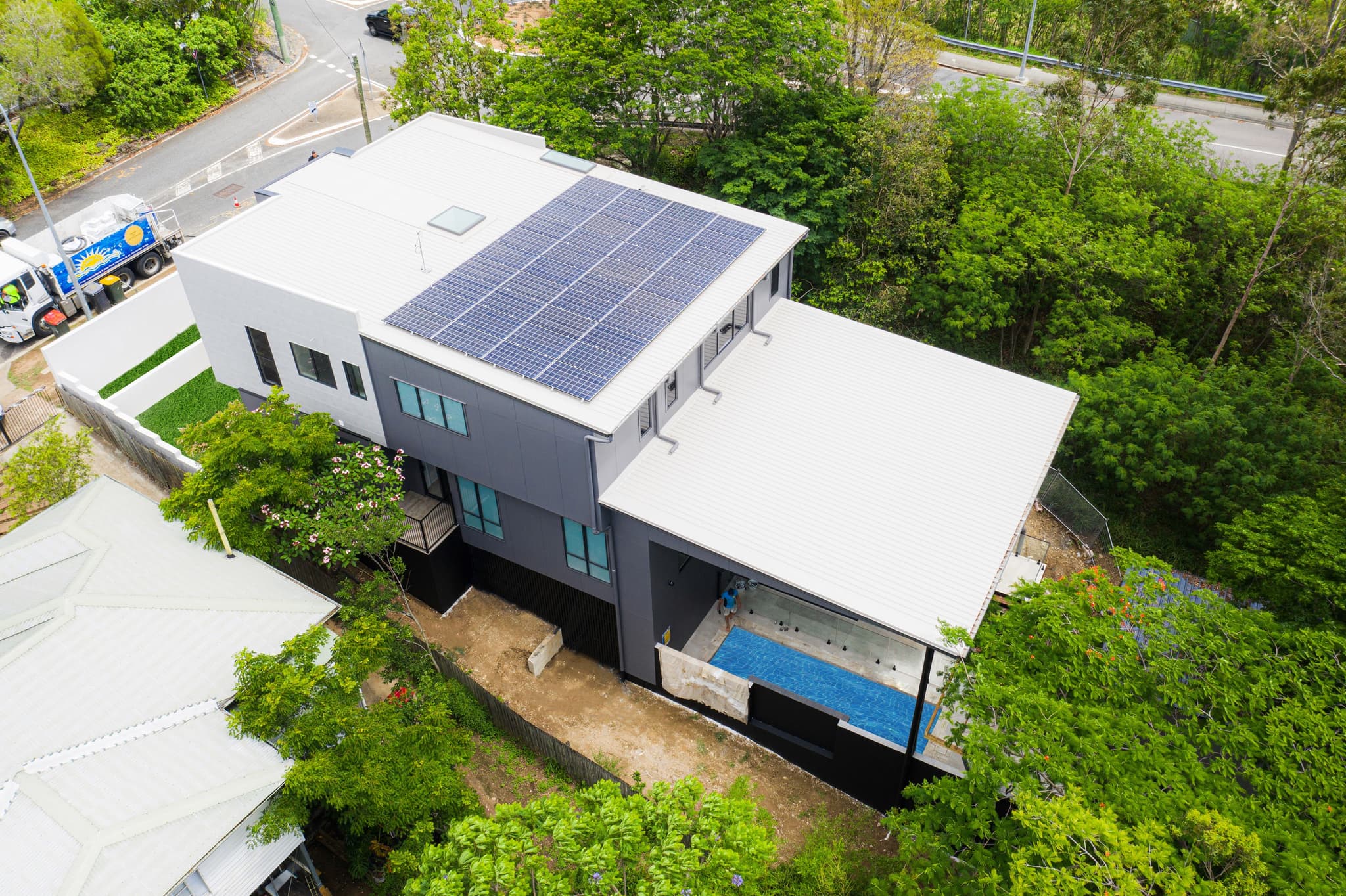
As custom builders, we view the gradient differently. Downward sloping block house designs are not about fighting the land; they are about leveraging the contour to your advantage. By working directly with the natural fall of the block, you can achieve unobstructed views, genuine backyard privacy, and distinct multi-level living spaces that a flat block simply cannot offer.
The Custom Builder's Approach: The most efficient and cost-effective earthworks strategy is always the one that touches the ground the least. A successful build adapts the floor plan to the hill, rather than bulldozing the hill to fit the floor plan.
Why Is a Downward Slope a Hidden Advantage?
A block that drops away from the street provides a natural canvas for a highly dynamic layout. The benefits are literally built into the landscape:
- Elevated Views and Natural Light: Your home is automatically positioned to capture unobstructed sightlines. Because rear living areas sit above your neighbours, your views are protected, and natural light can flood multiple levels.
- Enhanced Privacy: With the main living areas stepping down and away from street level, you gain a sense of seclusion. It creates a private rear sanctuary that isn't overlooked by passing traffic.
- Distinct Multi-Level Living: The gradient is perfect for creating separated zones without expanding the building's footprint, such as placing a quiet home office on one level and the primary family room on another. You can see practical examples of this in our completed projects.
What Structural Strategy Suits Your Sloping Block?
Selecting the correct foundation strategy is the decision that steers the entire project. The approach depends entirely on the severity of the gradient, the soil stability, and your lifestyle requirements.
The Split-Level Approach: Working With the Gradient
Split-level layouts are generally the most effective solution for blocks with a gentle to moderate fall. Instead of creating one large, flat concrete pad, the home is designed with staggered floor levels connected by short flights of stairs.
This drastically reduces the need for aggressive "cut and fill" earthworks. For example, the garage and entry might sit at street level, while a short flight of stairs leads down to the open-plan living area, creating a home that steps seamlessly with the hill.
Stilt and Podium Homes: Floating Above the Landscape
For sites that are incredibly challenging, rocky, or covered in protected vegetation, a stilt or podium design is highly effective. In fact, for very steep slope house plans, this is often the only viable structural option.
Instead of carving deeply into the hillside, the house is elevated on steel piers, timber posts, or a solid concrete platform. From the street, the home may appear as a modest single-storey structure, opening up at the rear to reveal multiple levels suspended over the slope.
Stepped Slab-on-Grade: A Terraced Foundation
The stepped slab-on-grade is a hybrid approach often suited for a small slope house design with highly stable soil. It involves pouring a series of level concrete slabs that step down the block, mimicking its contour. This provides the grounded feeling of a traditional slab foundation while allowing the footprint to adapt to the site.
Comparing Structural Approaches
Choosing the right typology is a critical design phase. Each approach has its own strengths and is better suited to different site conditions and budgets.
| Design Approach | Best Suited For | Excavation Level | Key Advantage |
|---|---|---|---|
| Split-Level | Gentle to moderate slopes | Low to Medium | Creates interconnected zones that work with the natural fall, minimising major retaining walls. |
| Stilt / Podium | Steep or rocky sites | Very Low | Preserves the natural landscape, captures elevated views, and minimises heavy earthmoving. |
| Stepped Slab | Moderate slopes with stable soil | Medium to High | Provides the solid feel of a slab foundation while creating a terraced layout. |
Why Do Foundations and Earthworks Matter So Much?
What you don't see is just as important as what you do. The longevity of a down slope house design comes down to subsurface engineering.
Before any design work is finalised, a geotechnical report is non-negotiable. This soil test reveals the site's subsurface conditions, including soil reactivity, rock ledges, and groundwater levels, which directly informs the foundation strategy.
Retaining Walls: From Function to Feature
On sloping sites, retaining walls are an engineering necessity to stabilise soil and create usable areas. However, they should be integrated as a design feature rather than an afterthought. Tiered retaining walls can transform a steep backyard into functional outdoor 'rooms', such as an upper paved patio, a mid-level lawn, and lower garden beds.
What Council Approvals Apply to Sloping Blocks in Brisbane?
Every local council has specific planning codes for hillside construction. Understanding these early prevents costly redesigns:
- Building Height Limits: Councils measure height from the 'natural ground level'. A stepped roofline ensures the home remains within the maximum height envelope as it moves down the hill.
- Bushfire Attack Level (BAL): Many sloping blocks back onto bushland gullies. If the land has a high BAL rating, specific fire-resistant building materials and access routes are strictly required.
- Environmental Overlays: Protected vegetation or natural overland flow paths will dictate the buildable envelope on your land.
(Note: If your sloping site also happens to sit on a street intersection, your council setbacks and driveway regulations become even more complex. Review our essential guide on corner block house designs: what to know before you build in Brisbane to prepare for dual-frontage rules.)
How Do You Find the Right Builder for a Sloping Block?
Standard project builders often attempt to force flat-land designs onto sloped sites through heavy excavation. A specialist custom builder takes a different approach, fusing structural engineering with site-specific building design to create a home that settles naturally into the landscape. For specifically what to check and ask before signing with a builder for a sloping site, our guide to choosing the right sloping block builders in Brisbane covers the vetting process in depth.
If you are exploring building on a sloping block for an upcoming project, the most important first step is understanding what the land will technically allow.
Frequently Asked Questions
Is a downward sloping block more expensive to build on than a flat block? Often, yes, but not always by as much as homeowners expect. The extra cost usually goes into foundations, retaining, and earthworks, but a well-matched structural strategy (like stilt construction on a steep block) can actually minimise excavation compared to forcing a flat-land design onto the same site.
What's the best foundation type for a very steep block? Stilt or podium construction is usually the only viable option once a slope becomes genuinely steep, since it avoids the extensive cut-and-fill or retaining that a slab-based approach would otherwise require.
Do I need a geotechnical report before designing for a sloping block? Yes. A soil test revealing reactivity, rock ledges, and groundwater conditions should happen before design work is finalised, since it directly determines which foundation strategy is viable for your specific block.
Can a sloping block actually improve my views compared to a flat block? Yes, this is one of the main advantages. Because rear living areas typically sit above neighbouring properties on a downward slope, sightlines are naturally protected in a way a flat block can't replicate.
Ready to Discuss Your Site?
The team at Flascon Construction Group specialises in crafting highly functional, custom homes on challenging Brisbane sites. Contact us for a site assessment to explore the exact structural potential of your block without the guesswork.
Keep reading
More Brisbane building guides
Building Guides6 min read
Your Pre-Handover Inspection Checklist for a New Home in Queensland
What to check at the pre-handover inspection of a new home in Queensland, what your builder hands you at practical completion, and what counts as a defect.
Building Guides7 min read
Knockdown Rebuild in Brisbane: The Step-by-Step Process
How a knockdown rebuild works in Brisbane, step by step: feasibility, demolition approval, asbestos, services, soil testing, building approval and construction.

Building Guides6 min read
Building Contracts in Queensland: Fixed Price vs Cost Plus
Fixed price and cost plus building contracts explained for Queensland home builds, plus the deposit, payment and paperwork rules the QBCC sets.