
Building on a Sloping Block in Brisbane
Published Updated 8 min read
On this page
- What Makes a Sloping Block Cheaper to Build On
- Cut and Fill vs Split-Level: The Two Ways to Build on a Slope
- How Do You Manage Drainage on a Sloping Block?
- What Are Brisbane's Driveway Gradient Rules for a Sloping Block?
- Orientation and Passive Design on a Slope
- What Council Approvals Do You Need for a Sloping Block in Brisbane?
- The Geotechnical Report and Why It Comes First
- What a Sloping Block Build Involves
- Ready to Build on Your Sloping Block?
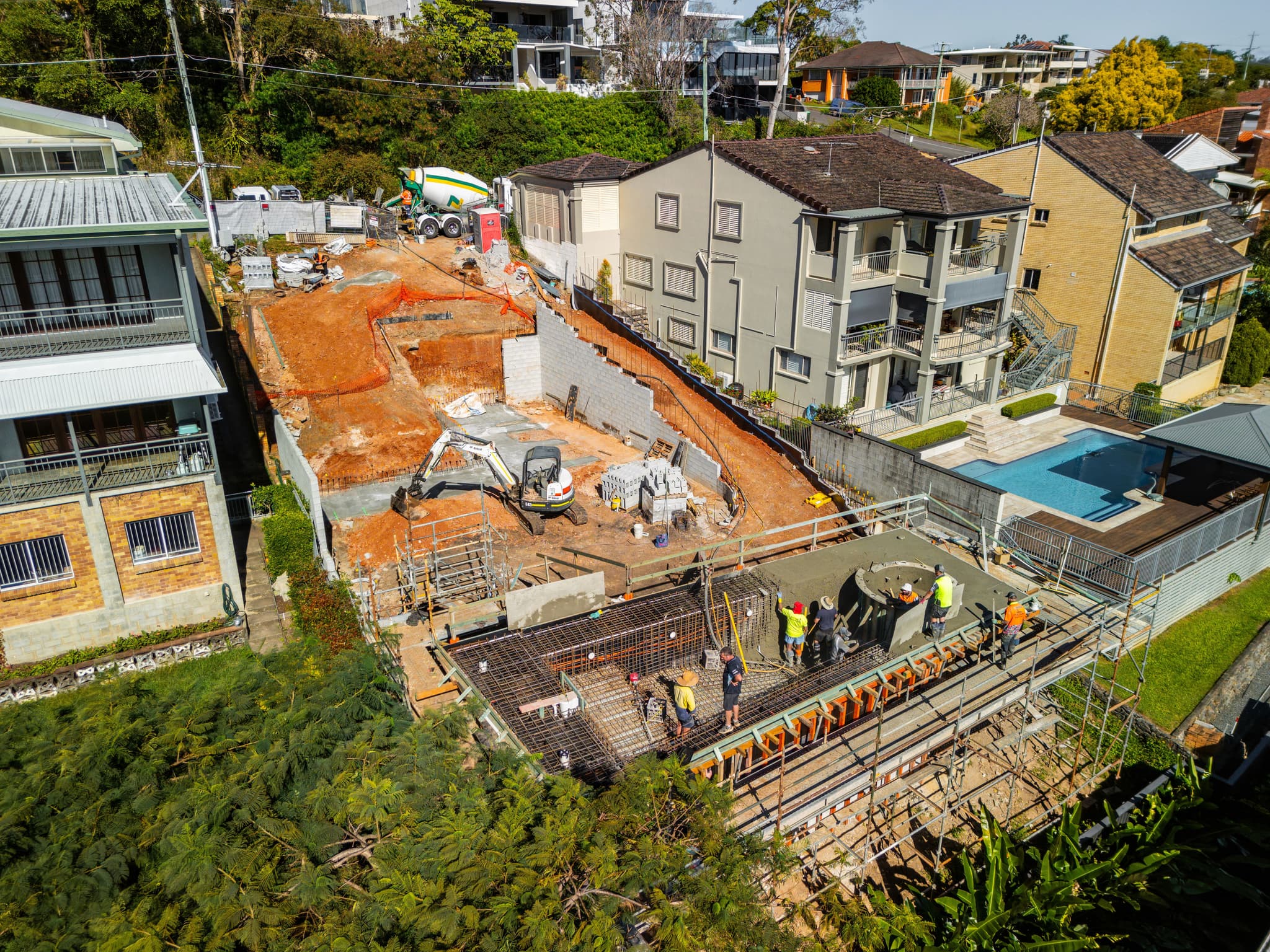
Building on a sloping block in Brisbane is entirely achievable, and it's something our sloping block specialists take on as a matter of course, but it changes several decisions a flat-block build doesn't have to make. How you handle earthworks, how stormwater moves across the site, what driveway gradient council will approve, and what your soil report tells your foundation design all shift once a block has a real fall to it. In our experience, sloping sites in Brisbane are usually built one of two ways: cut and fill, or a split-level design. Which one suits your block depends on the fall, the soil conditions, and the floor plan you're chasing.
This guide walks through what changes when you build on a slope, so you know what to expect and what questions to bring to your first site assessment.
What Makes a Sloping Block Cheaper to Build On
Not all sloping blocks cost the same to build on, and a few practical checks before you buy can make a genuine difference to your budget.
- A fall under 2 metres is generally the most economical starting point. Once a block's fall goes much beyond that, earthworks, retaining, and foundation costs climb accordingly. Still entirely buildable, just worth budgeting for.
- A block sloping toward the street is generally easier to manage than one sloping away from it. Water naturally moves toward the existing stormwater system rather than needing to be captured and redirected from the rear of the block, which usually means simpler, less costly drainage design.
- Check for underground services running through the block (water, sewer, stormwater mains) before committing. They don't rule a block out, but knowing about them early avoids a costly surprise once earthworks begin.
- Overland flow paths matter as much as the visible slope. A block can look manageable on the surface but sit on a mapped flow path that adds its own drainage requirements.
None of this rules out a steeper or more complex block. There are ways to work with almost any slope, which is what the rest of this guide covers. It just means the more of these boxes a block ticks, the more cost-effective the build is likely to be from the outset.
Cut and Fill vs Split-Level: The Two Ways to Build on a Slope
There are two established approaches to sloping block construction in Brisbane, and the right one depends on the slope angle, the soil conditions, and the design you're after.
| Method | How it works | Best suited to | Trade-off |
|---|---|---|---|
| Cut and fill | The high side of the site is excavated and that soil is used to build up the low side, creating one level pad | Blocks with a moderate, consistent fall where a more traditional single-level footprint is wanted | More earthworks and engineered retaining walls, and it alters the site's natural drainage patterns |
| Split-level | Floor levels step down with the gradient connected by short flights of stairs | Steeper or irregular blocks, and designs shaped around the site | Requires site-specific structural design |

As a guide, a site with a 3-metre fall built using cut and fill might involve excavating around 1.5 metres at the rear and adding roughly 1.5 metres of fill at the front, though your geotechnical report and structural engineer will confirm the figures for your block. A split-level design avoids most of that earthmoving by stepping the home with the land instead: garage and entry at one level, for example, with living areas stepped down or up to meet the outdoor space.
How Do You Manage Drainage on a Sloping Block?
Water management is one of the more technical parts of building on a slope. Uncontrolled water flow during heavy rain can cause erosion and, over time, structural issues, so drainage needs to be designed into the build, not bolted on after.
The standard solutions we work with include:
- Sub-soil drains (agricultural pipes): perforated pipes installed underground behind retaining walls and along foundations, collecting rainwater and channelling it away before it builds up pressure against the structure.
- Surface drains and swales: channels built into the landscaping that collect rainwater from roofs and paved areas and direct it to council stormwater systems.
- Waterproofed retaining walls: any retaining structure needs waterproofing on the soil side plus integrated drainage, or water pressure will eventually cause it to fail.
- Permeable surfaces and landscaping: permeable paving on driveways allows water to infiltrate rather than run off, and garden beds can be shaped to act as swales that carry water away from the building.
What Are Brisbane's Driveway Gradient Rules for a Sloping Block?
Site access affects both the construction process and how usable your home is day to day. Brisbane City Council sets specific gradient rules for driveways on sloping sites:
| Location | Maximum gradient |
|---|---|
| Inside the property | 1:4 (25%) |
| Outside the property boundary | 1:6 |
| Gradient transition (to prevent vehicles bottoming out) | 1:12, over a minimum length of one metre |
These figures come directly from Brisbane City Council's driveway technical standards, and a design that exceeds these thresholds won't get council approval. Get your driveway calculations sorted early, before you commit to a design. Beyond compliance, think about daily use: loading and unloading, wet-weather grip, manoeuvring larger vehicles. A turning bay or a wider garage entry makes a real difference on a steep site.
Access also affects cost. Sites with limited or steep access sometimes need a crane for material delivery, which means more planning and coordination on our end, but it shouldn't come as a surprise partway through the build.

Orientation and Passive Design on a Slope
Where your home faces determines light, warmth, and how well it copes with Brisbane's climate, and that's before you even factor in the view. North-facing orientation gives the best passive solar access here: natural light and warmth in winter, with well-placed eaves shading the harsher summer sun. The Australian Government's YourHome guide sets the principle out in more detail.
Where the best views face west, or another direction that isn't ideal for passive design, there are ways to manage the trade-off:
- High-performance glazing to reduce heat transfer
- External shading such as louvres, awnings, or deep eaves
- Cross-ventilation to keep air moving through the home
Done well, this means you don't have to choose between the view and the home's thermal performance.
What Council Approvals Do You Need for a Sloping Block in Brisbane?
Brisbane City Council assesses sloping block applications against a specific set of criteria that don't apply to flat sites:
- Overland flow paths: the natural route water takes across your site in heavy rain has to be preserved. A design can't block or divert stormwater onto a neighbouring property.
- Height restrictions: building height on a sloping site is measured from natural ground level, and it needs to be documented carefully in the application.
- Protected Vegetation: significant trees on private property can be protected by a Vegetation Protection Order under Council's Natural Assets Local Law, and a design has to work around them. Council's Protected Vegetation Enquiry is address-based and emails back a map and report, so it's worth running before you finalise a footprint. Biodiversity and waterway corridor overlays in City Plan 2014 can apply on the same site, so a clear vegetation search doesn't always mean a clear site.
These assessments run in parallel with design rather than after it, so the footprint, height and stormwater strategy are shaped by the constraints from the first sketch.
The Geotechnical Report and Why It Comes First
Before detailed design work begins, the block needs a geotechnical report. A geotechnical engineer takes soil samples to assess stability, composition, and reactivity, then assigns a site classification under AS 2870, the standard the NCC references for residential footings and slabs.
The report tells you:
- Your site classification (Class A is stable sand or rock, Class M is moderately reactive clay, Class H is highly reactive)
- The foundation approach the soil requires
- Any conditions to plan around (unstable soil, rock, or high groundwater)
- The engineering specifications your retaining walls will need
Site classification drives both foundation type and cost. A Class A site needs comparatively little foundation work. Class H, E and P sites need more substantial systems, and they also fall outside the simplified footing tables in the ABCB Housing Provisions, which means a structural engineer has to design to AS 2870 directly. On a sloping block that's a real cost line, and it's worth knowing before you commit to a design.
What a Sloping Block Build Involves
Once the approach and approvals are settled, sloping block construction typically covers:
- Site preparation and earthworks: excavation, cut and fill, and levelling
- Engineering: the geotechnical report, structural engineering for foundations and retaining walls, and stormwater engineering for drainage
- Foundations: sloping sites often call for screw piers, deep-bored piers, or stepped footings rather than a standard concrete slab
- Retaining structures: engineered walls with integrated drainage and waterproofing built in from the start
A proper site assessment upfront, covering topography, geotechnical conditions, existing drainage patterns, and access logistics, gives you a realistic picture of scope before you commit to a design.
Once you've got a feel for how the build itself works, the next question is usually what your home could actually look like. Our guide to house designs for sloping blocks picks up from here. If a pool is part of the plan, sloping sites offer some real advantages. Our guide to building a custom home and pool covers how to integrate one from the outset.
Ready to Build on Your Sloping Block?
The right approach depends on your site's fall, soil and outlook, which is why the site assessment comes before the floor plan. Flascon Construction Group is a QBCC licensed builder (Licence 15050857) building across Brisbane and South East Queensland, and sloping sites in suburbs like Norman Park, Coorparoo and Carindale are a regular part of our work.
Complete a free site feasibility check to find out what your block will need before you commit to a design, or browse our completed projects to see how we've handled sloping sites.
Keep reading
More Brisbane building guides
Custom Home Design8 min read
Brisbane Small Lot Builder: Custom Small Lot House Designs
Real strategies from a Brisbane small lot builder for maximising light, layout, and space, plus how to navigate council compliance.
Building Guides5 min read
The Real Cost of a Knock Down Rebuild in Brisbane
A knock-down rebuild in Brisbane typically costs $520,000–$1.3 million+. See the real cost breakdown: demolition, design, construction, and fees
Building Guides6 min read
Split Level House Plans for Sloping Blocks in Brisbane
Split level house plans for sloping Brisbane blocks: back split, side split, standard split, and stacked split, plus how tri-level compares.
Quick answers
What are the main ways to build on a sloping block?
Two primary approaches are used in Brisbane: cut and fill, which excavates the high side and fills the low side to create a level building pad held by engineered retaining walls; and split-level designs, which step tiered floor levels with the gradient, requiring less excavation because the home works with the slope rather than against it.
Do I need a geotechnical report for a sloping block?
Yes, a geotechnical report is required before detailed design work. An engineer takes soil samples to determine stability, composition and reactivity, providing the soil classification, foundation requirements and retaining wall specifications. Site class drives foundation cost: stable Class A soil needs minimal work, while highly reactive Class H or E soils need more extensive systems.
How steep can a driveway be in Brisbane?
Brisbane City Council caps driveway gradients at 1:4 (25%) inside the property and 1:6 outside the boundary, with gradient changes limited to a maximum of 1:12 over at least one metre so vehicles don't bottom out. Designs exceeding those thresholds won't receive council approval, so experienced builders run these calculations early in the design phase.