
Build Your Flood Proof House: Brisbane 2026 Guide
Published Updated 7 min read
On this page
- What a Flood-Resilient Home Actually Gives You
- What Does a "Flood Proof House" Really Mean in Brisbane?
- Flood Zone Versus Overland Flow: What's the Difference?
- Flood Resilience Strategy Comparison
- What Brisbane's Flood Rules Mean for Your Build
- What Flood Resilience Costs, and Where the Money Goes
- Renovate, Retrofit or Knock Down and Rebuild?
- Your Flood-Resilient Site Assessment Checklist
- Frequently Asked Questions About Flood Proof Homes
- Start With the Site, Not the Floorplan
If you are weighing up a block in Brisbane or South East Queensland and asking whether you can build a flood proof house, you are already thinking about the right things: whether the site has flooded before, what council will allow, how painful insurance might be, and whether you could spend serious money and still be left exposed.
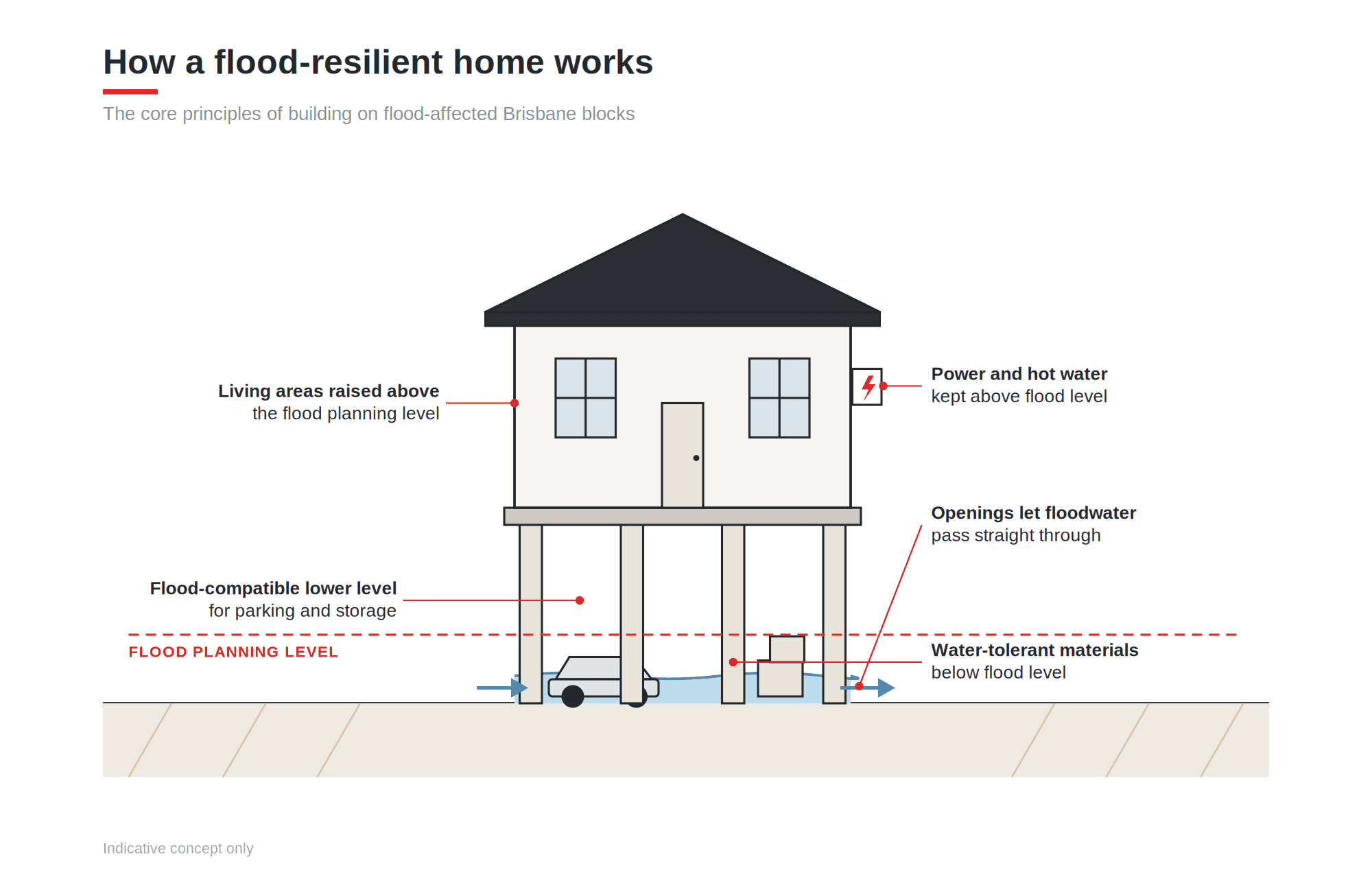
Here is the honest answer we give homeowners. No home can be made completely flood proof. But on almost any Brisbane block, you can build a genuinely flood-resilient home: one that keeps living areas out of harm's way, limits damage when water does arrive, and gets you back to normal quickly.
In Queensland, the more useful question isn't whether a home can be made immune to water, it's how to design one so that when water does arrive, it causes less damage, you're back in sooner, and the home still holds its value over the long run.
What a Flood-Resilient Home Actually Gives You
- Protected living areas: your everyday spaces sit above the levels floodwater is likely to reach.
- A smaller damage bill: the areas that can flood are built from materials that clean up and recover.
- Faster recovery: you get back into the home quickly, without a full strip-out after every event.
What Does a "Flood Proof House" Really Mean in Brisbane?
The term "flood proof house" sounds clear, but in practice it is misleading. In Brisbane and SEQ, the real aim is flood resilience. Water can overtop, seep, backflow, or arrive in ways a generic design never anticipated, so a promise that a home will never take on water is marketing, not engineering.
When homeowners say "flood proof", they usually mean the same three things covered above: keeping water out of living areas, limiting damage where it can't be avoided, and getting back into the home quickly afterward. Those are sensible goals. They are just not the same as promising the house will never flood. Floor heights, subfloor design, service locations, drainage, external levels, and the materials below the likely flood level all have to work together.
Flood Zone Versus Overland Flow: What's the Difference?
The two get confused often enough that it's worth separating them clearly.
Creek or river flooding is the one most people picture: water rises from a waterway and spreads across surrounding land in a big rain event. Blocks closer to those corridors carry the most obvious exposure.
Overland flow is different. It's stormwater running across the ground surface on its way to a drain, creek or river, following the natural low points of the land. Because it's about the path water takes rather than how close you are to a waterway, an overland flow path can cross a block that's nowhere near an obvious creek or river, which is why an ordinary-looking block can still carry an overland flow notation. Brisbane City Council sets out these categories, along with storm tide and other flood types, on its flooding in Brisbane page.
Flood Resilience Strategy Comparison
| Strategy | What it does | Best For | Key Consideration |
|---|---|---|---|
| Elevation | Raises habitable areas above the likely flood level | Knockdown rebuilds, new custom homes, low-lying and river-adjacent blocks | Affects stairs, facade proportions, garage layout and budget |
| Wet floodproofing | Lets water into enclosed lower non-habitable areas using flood-compatible materials and openings | Ground-level parking, storage and undercroft areas | Only works when the lower area is designed for inundation and easy clean-out |
| Dry floodproofing | Resists water entry with barriers and sealing details | Shallow or less severe exposure, targeted protection | Has real limits once water depth, velocity or duration increase |
| Flood-resistant materials | Uses water-tolerant construction below flood level | Any area with credible flood exposure | Must include concealed fixings, connectors and corrosion resistance |
| Elevated services | Lifts electrical, hot water and mechanical systems above flood level | Almost every flood-aware build | Most cost-effective when planned at design stage |
What Brisbane's Flood Rules Mean for Your Build
Before you fall in love with a floorplan, we always recommend pulling a FloodWise Property Report from Brisbane City Council. It shows the likelihood and type of flooding for a specific address and gives the technical flood levels that certifiers and engineers work to.
(FloodWise is specifically a Brisbane City Council tool. If your block sits in Moreton Bay, Logan, Ipswich, or elsewhere across South East Queensland, your own council will have an equivalent flood mapping tool or property report, worth requesting the same way.)
On flood-affected projects, the building certifier should be part of the conversation early.
It may change decisions owners often assume are purely aesthetic:
- Entry height: your front door may need more steps, a different path, or a split-level approach.
- Garage arrangement: the garage may sit differently to the main living floor, or become part of a more flood-compatible lower level.
- Ground-floor use: a room you hoped to use as a media room or bedroom may need to stay non-habitable, depending on the site constraints and approval pathway.
- Structure below the house: enclosed areas under raised living space need to be detailed for water passage and recovery, not treated like ordinary dry rooms.
What Flood Resilience Costs, and Where the Money Goes
That cost usually shows up in a few places:
- Structure: higher floors, piers, posts, slabs or engineered subfloor systems.
- Services: relocating electrical, hydraulic, and mechanical items above flood level.
- Materials: upgrades to lower-level walls, linings, fixings, doors, cabinetry and insulation.
- External works: site falls, drainage and retaining that give water a predictable path.
Renovate, Retrofit or Knock Down and Rebuild?
On a flood-affected block, this is often the real decision, and it depends on the house and the site. A retrofit can make sense where the existing structure allows meaningful improvement, especially if you can relocate services, rework lower-level materials and improve how water moves through the site. But some older homes are fighting the block from the start.

In those cases, a knock down and rebuild gives you far more control over floor levels, structure, use of the lower floor and compliance, which is exactly what a flood-prone site demands. If you're weighing the numbers, our guide on what a knockdown rebuild costs in Brisbane is a good starting point.
Your Flood-Resilient Site Assessment Checklist
- Check the property's flood history. Ask what has actually happened on the block, not just what a sales listing says. Previous owner disclosure, neighbour knowledge and past repair evidence all help.
- Review site levels and contours. A flat-looking block can still channel water badly. Know where the low points are and how water enters and exits.
- Understand nearby waterways and catchment behaviour. Look beyond the obvious creek or river to local rainfall, upstream runoff and street drainage.
- Look at adjoining properties. Boundary walls, fill, fences and hard surfaces next door can redirect flow across your title.
- Ask where the habitable floor can realistically go. This affects stairs, facade, parking and whether the design still suits your lifestyle, so it needs to happen early.
- Confirm what sits below the flood level. Decide now what any flood-exposed space is for, and what materials belong there.
Frequently Asked Questions About Flood Proof Homes
Can a house in Brisbane really be flood proof? Not in the absolute sense. On SEQ blocks, the better target is a home designed for a known level of flood risk that limits damage when water arrives and is easier to clean, repair and reoccupy.
What happens if a flood exceeds the design level? A resilient design does not promise zero damage beyond the event it was designed for. It aims to make the outcome less severe. If water goes higher than planned, what matters is the fallback: which materials are exposed, whether services can be isolated safely, and whether the lower structure traps water or lets it pass.
Do cosmetic upgrades count as flood protection? Usually not on their own. Premium finishes in the wrong location add cost without adding resilience. The upgrades that matter are tied to levels, structure, services, drainage and materials that can take direct water contact.
Can you still build on a flood or overland flow site at all? In most cases, yes. Flood and overland flow blocks are built on regularly across Brisbane. What changes isn't whether you can build, it's how the home responds to the site, and that response works best when it's planned around the site from the start, not bolted on after the design is already settled.
Start With the Site, Not the Floorplan
A flood-resilient home isn't always the one that resists water everywhere. More often it's the one that lets water move where it must, while protecting the parts of the home that matter most. Get the site right first, and the design decisions that follow become far clearer.
Flood and overland flow are just one of several site conditions worth checking early, our guide to building on a difficult site in Brisbane covers the others, sloping, narrow, corner and acreage blocks each have their own version of this same "check it before you design around it" logic. On rural and bushland blocks specifically, flood risk often sits alongside a bushfire overlay too, our guide to building on acreage covers both together.
If you are planning a custom home, duplex, or knockdown rebuild on a flood-affected or low-lying block in Brisbane, we can help you assess the site constraints early. Start the conversation with our team for an initial discussion about your build.
Keep reading
More Brisbane building guides
Building Guides6 min read
Your Pre-Handover Inspection Checklist for a New Home in Queensland
What to check at the pre-handover inspection of a new home in Queensland, what your builder hands you at practical completion, and what counts as a defect.
Building Guides7 min read
The Knockdown Rebuild Process in Brisbane: A Step-by-Step Guide
How a knockdown rebuild works in Brisbane, step by step: feasibility, demolition approval, asbestos, services, soil testing, building approval and construction.

Building Guides6 min read
Building Contracts in Queensland: Fixed Price, Cost Plus and What the QBCC Requires
Fixed price and cost plus building contracts explained for Queensland home builds, plus the deposit, payment and paperwork rules the QBCC sets.