
Standard Ceiling Height Australia: A Practical Guide
Published Updated 5 min read
On this page
When planning a new custom home in Brisbane, ceiling height is one of the most impactful decisions you will make. While there is no single 'average' ceiling height in Australia, a clear trend has emerged. Legally, the National Construction Code (NCC) requires a minimum ceiling height of 2.4 metres for habitable rooms. However, an increasing number of homeowners and premium builders are embracing 2.55 metres or 2.7 metres as the new standard. This subtle increase delivers a significant return in spatial volume, natural light, and passive cooling.
Understanding Australian Ceiling Height Standards
The National Construction Code (NCC) acts as a baseline for residential building standards across Australia. Understanding these minimums allows you to make strategic design choices:
- Habitable Rooms (2.4m minimum): These are primary living spaces, including bedrooms, living rooms, and dining areas.
- Non-Habitable Rooms (2.1m minimum): This covers utility and transition spaces such as kitchens, bathrooms, laundries, and hallways.
While a 2.4-metre ceiling is fully compliant, treating it as the default can limit your home's potential. By stepping up to 2.7 metres in your primary living zones, you immediately elevate the home from standard to custom, while maintaining 2.4 metres in utility areas to manage your overall investment. Getting familiar with the essentials of constructing a new house in Brisbane will help you make these kinds of informed decisions.
The Evolution of Ceilings in Australian Homes
The current legal minimum of 2.4 metres is a product of past economic limitations, not a blueprint for exceptional subtropical living. The history of Australian ceiling heights actually began with a focus on climate response. In 1810, Governor Lachlan Macquarie mandated a minimum ceiling height of nine feet (2.7 metres) as a public health measure to allow hot air to rise and escape.
During the prosperous Victorian era of the 1860s, wealthy homeowners built magnificent homes with soaring ceilings ranging from 3.6 to 4.2 metres. These impressive volumes acted as a brilliant form of natural air conditioning. However, following World War II, economic austerity and material shortages forced a shift to more cost-effective, mass-produced building. Regulators lowered the minimum height to 2.4 metres to house families quickly and affordably. Today's shift back toward 2.7-metre ceilings is a return to a design philosophy that has always made sense for the Queensland climate.
How Taller Ceilings Impact Your Building Budget
A common question during the design phase is how much extra it costs to raise the ceiling line. While it does increase the initial budget, the final figure is often highly proportional to the overall lifestyle payoff. Raising the ceiling requires longer wall studs, additional plasterboard, and structural engineering adjustments. Aesthetically, taller walls also demand taller internal doors and larger window profiles to maintain correct proportions. While this increases construction costs, it is widely considered one of the most secure investments in custom home design.
When you're looking at a major project, understanding the real cost of a knock-down rebuild in Brisbane can help you see where an upgrade like this fits into the overall picture.
When planning increased ceiling heights, it is important to remember how this affects other systems. Taller ceilings mean more air volume, which impacts your mechanical heating and cooling requirements. Your air conditioning must be sized correctly to handle the larger space efficiently. Using an air conditioner room size calculator provides an accurate estimate of what your rooms will require. This ensures you are not under-powering your system, which would negate the energy savings gained from passive cooling.
Designing for Light, Air, and Space
Higher ceilings are one of the most effective ways to influence the three pillars of a comfortable home: light, air, and space.
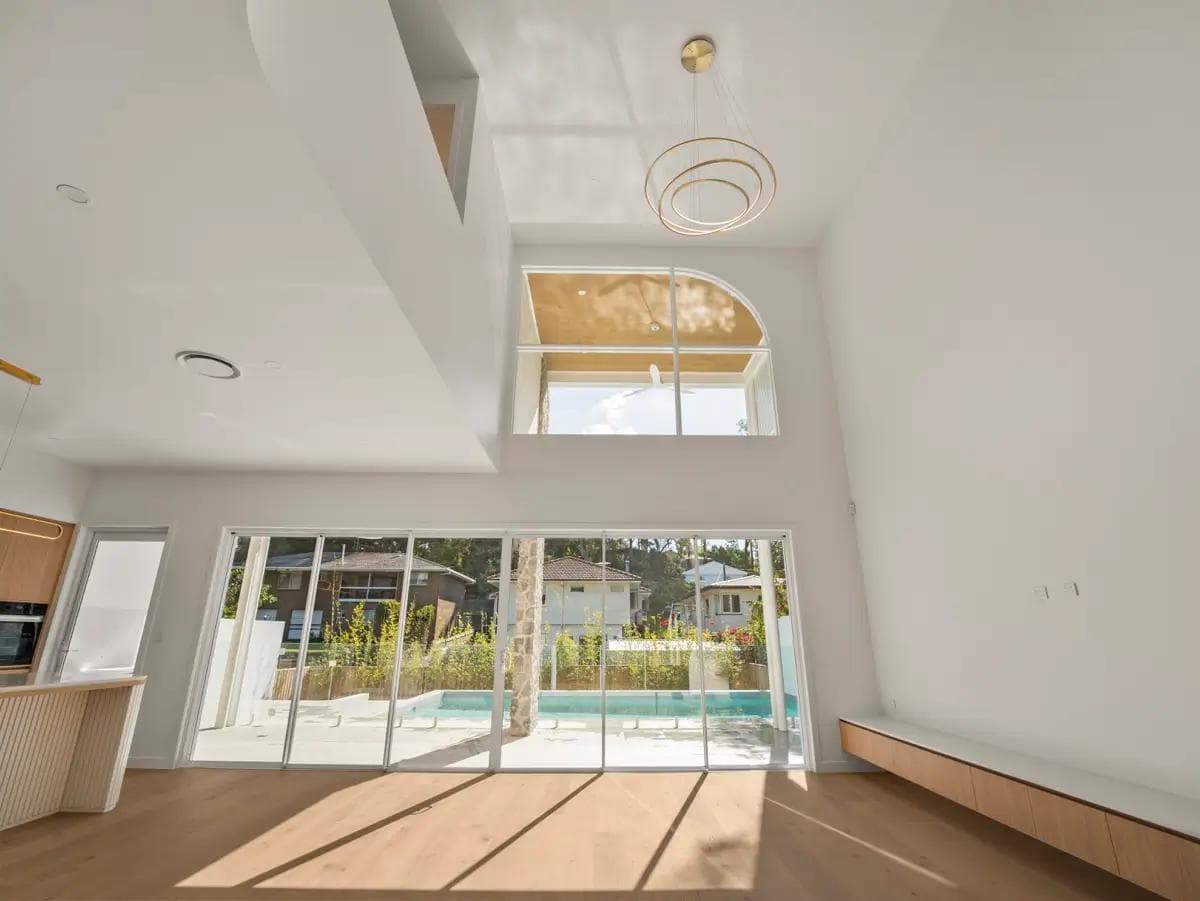
In Southeast Queensland, extra vertical volume is a highly effective passive cooling strategy. Because hot air naturally rises, a taller ceiling allows warm, stale air to move up and away from the living zone. When paired with clerestory windows or strategically placed high louvres, this trapped heat can easily escape, creating a natural convection current that significantly reduces your reliance on air conditioning. We explore this further in our blog on solar passive home designs.
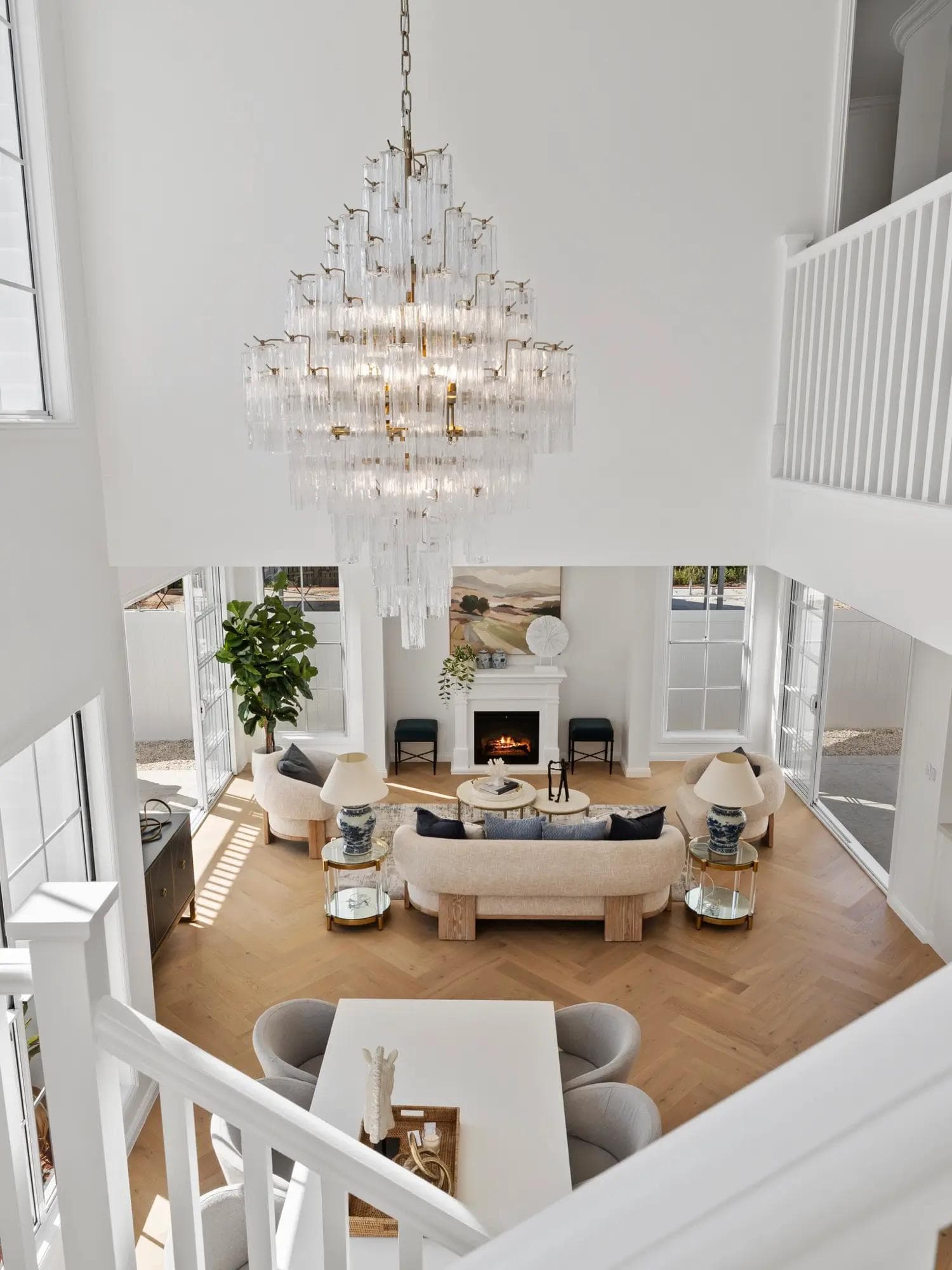
From a design perspective, higher ceilings provide the necessary clearance for statement features. A 2.7-metre ceiling allows large pendant lights to hang at the perfect visual height over a dining table without compromising headroom. It also provides the space required for ceiling fans to circulate air efficiently and enables floor-to-ceiling cabinetry, which draws the eye upward and accentuates the room’s scale.
Strategic Design: Mixing Ceiling Heights
You do not need a uniform ceiling height throughout the entire home. A savvy design-and-construct team will play with ceiling levels to create architectural interest while managing your budget wisely. A highly effective strategy is to create a 'sense of arrival.' You might design a grand entry foyer with a soaring 3.0-metre ceiling to make an immediate statement. This can then transition into a relaxed living area with a comfortable 2.7-metre ceiling, while adjoining spaces like a butler's pantry or laundry drop to the standard 2.4-metre minimum. This intentional change in height defines distinct zones and gives the home a custom, luxurious feel without the cost of raising every single ceiling.
Frequently Asked Questions
Is 2.7m Always the Best Ceiling Height? Not necessarily. The ideal height depends on the proportions of the room. A very small powder room or study with a towering ceiling can feel disproportionate. In these spaces, dropping the ceiling to 2.55m or 2.4m creates a more balanced, intimate atmosphere.
Will Higher Ceilings Make My Energy Bills Increase? This is a common misconception. While more volume technically means more space to heat and cool, in Queensland's climate, the passive cooling benefits usually outweigh the drawbacks. By designing a 'thermal chimney' that allows hot air to rise and vent out, higher ceilings actively reduce your need for mechanical cooling during the hottest months.
How Does a Sloping Block Change My Ceiling Options? Sloping blocks are an excellent opportunity for dynamic ceiling design. A split-level layout naturally lends itself to raked or stepped ceilings that follow the contour of the land.
Planning higher ceilings as part of a premium build? See how we approach luxury home building in Brisbane.
Choosing your ceiling height is a foundational decision that influences everything from the feeling of a room to your home's long-term value. With over 30 years of experience bringing custom homes to life across Brisbane, the team at Flascon Construction Group, custom home builders in Brisbane, is here to guide you. Contact us today.
Keep reading
More Brisbane building guides
Building Guides5 min read
The Real Cost of a Knock Down Rebuild in Brisbane
A knock-down rebuild in Brisbane typically costs $520,000 to $1.3 million+. The full breakdown: demolition, design, construction, approvals and timeline.
Building Guides4 min read
Open Plan Home Design Brisbane: A Builder's Guide
Planning an open plan home design in Brisbane? A custom builder explains the structural realities, acoustic solutions, and layout zoning for seamless living.
Custom Home Design7 min read
Passive Home Design: A Builder's Guide for Brisbane & SEQ
Solar passive home design for Brisbane's subtropical climate: orientation, shading, thermal mass, and insulation strategies that genuinely cut energy bills.
Quick answers
What is the standard ceiling height in Australia?
The National Construction Code requires a minimum of 2.4 metres in habitable rooms such as bedrooms and living areas, and 2.1 metres in non-habitable spaces like bathrooms, laundries and hallways. There is no single 'average', but 2.55-metre and 2.7-metre ceilings have become the new standard among homeowners and premium builders.
Do higher ceilings cost more to build?
Yes, raising the ceiling line requires longer wall studs, additional plasterboard and structural engineering adjustments, and taller walls also demand taller internal doors and larger window profiles to keep proportions right. It increases the initial budget, but it is widely considered one of the most secure investments in custom home design.
Will higher ceilings increase my energy bills?
In Queensland's climate the passive cooling benefits usually outweigh the extra volume. Hot air rises, so taller ceilings let warm air move up and away from the living zone. Paired with clerestory windows or high louvres it escapes entirely, reducing reliance on air conditioning. Just make sure your system is sized for the larger air volume.